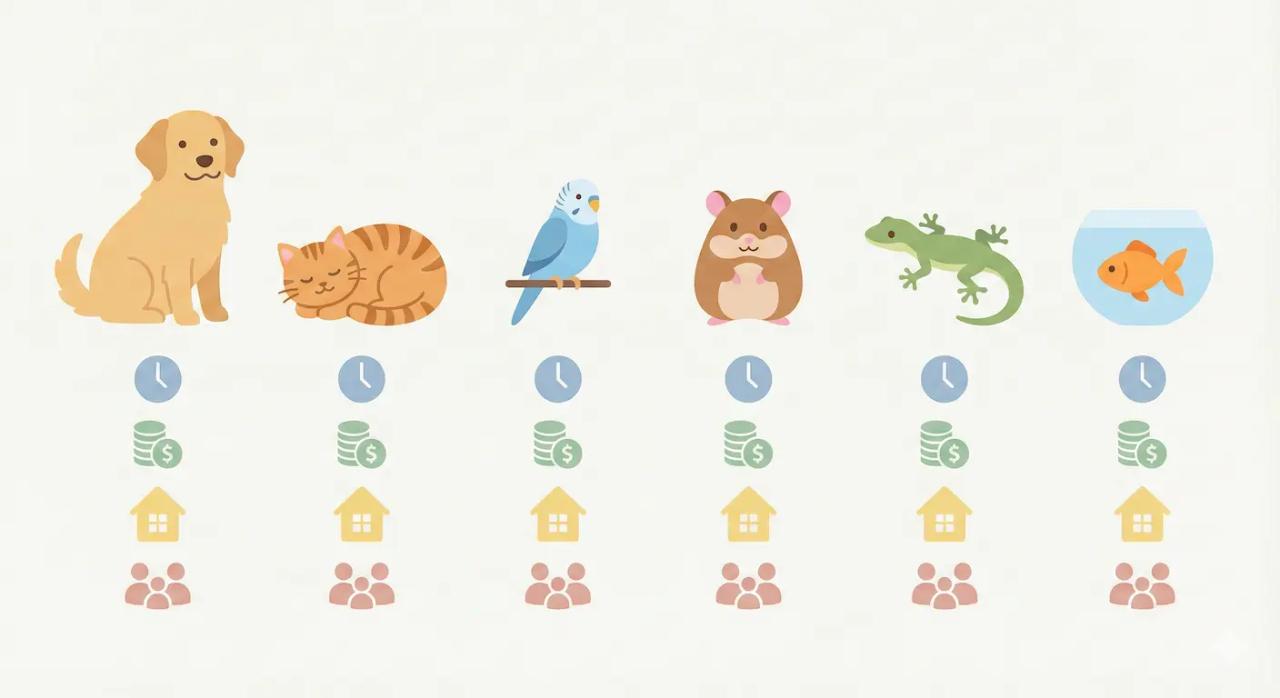
How to Choose the Right Pet for Your Lifestyle
Choosing a pet isn’t about the cutest face—it’s about the best fit. This beginner-friendly guide maps your routine, space, and budget to the pet that will thrive with you.
Why Fit Matters (and How This Guide Works)
A great match means fewer behavior issues, lower stress, and a happier home. This guide:
- Helps you audit your lifestyle honestly.
- Summarizes species needs (dogs, cats, birds, reptiles, fish, small mammals).
- Gives clear matches for common lifestyles (active, busy, family, etc.).
- Ends with a decision flow so you can act with confidence.
Step 1: Audit Your Lifestyle
Answer honestly—future you (and your future pet) will thank you.
Time & Routine
- Hours away on weekdays: <4 • 4–8 • 8+
- Travel frequency: rare • monthly • frequent international
- Daily availability for care: 15 min • 30–60 min • 1–2 hrs • 2+ hrs
Space & Housing
- Home type: studio/apt • house w/ yard • rural
- Restrictions: landlord rules, breed/weight limits, exotics allowed?
- Climate: extreme heat/cold? (affects breed/species choice)
Energy & Engagement
- Prefer runs/hikes, walks/play, or quiet evenings?
- Hands‑on handling okay? Or prefer observing (e.g., fish/reptiles)?
Health & Allergies
- Any dander/asthma concerns? Consider low‑shedding dogs/cats or non‑furry pets (reptiles, fish). Always test exposure first.
Experience Level
- Beginner vs experienced (training/grooming/exotics). Be realistic.
Household
- Kids (ages), elderly, and existing pets (species/temperament).
Budget (Monthly + Annual)
- Food, litter/bedding, toys, grooming, vet care & preventives, pet insurance, emergency fund. Bigger pets/exotics often cost more.
Step 2: Understand Pet Types
High‑level view for beginners. (Ranges vary by region and individual.)
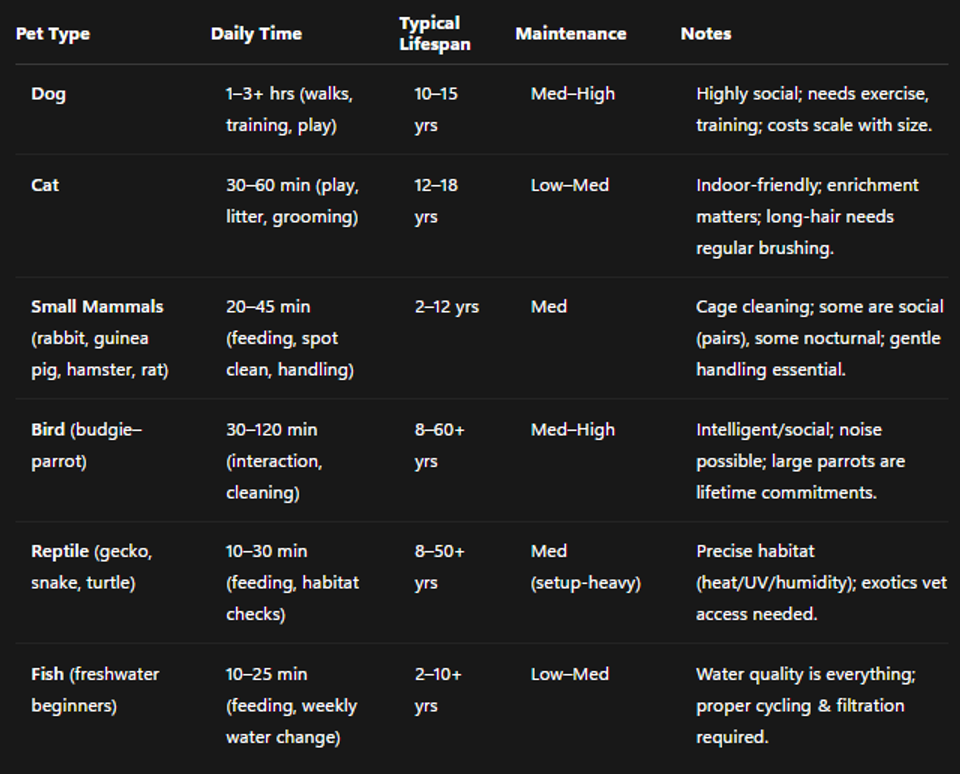
Tip: “Low‑maintenance” ≠ “no maintenance.” Reptiles and fish need correct environments to stay healthy.
Step 3: Match by Lifestyle Persona
A) Active Outdoorsy
Best fits: medium/large dogs (sporting/herding mixes), adult cats with playtime, rats/ferrets (interactive), some parrots.
- Why: You can provide daily exercise/enrichment.
- Watch‑outs: High‑energy dogs need structure; travel plans should include care.
B) Busy Professional (8+ hrs away)
Best fits: cats, fish, low‑interaction reptiles, hamsters/gerbils.
- Why: Independent, tolerate daytime solitude.
- Watch‑outs: Still need daily engagement (play, habitat maintenance).
C) Homebody / Low‑Key
Best fits: adult/senior cats, small dogs with modest exercise needs, fish, beginner reptiles (e.g., leopard gecko), guinea pigs.
- Why: Consistent presence, calm environment.
- Watch‑outs: Guinea pigs need companions (pairs) and space; cats still need play.
D) Family with Young Kids
Best fits: patient dogs (family‑friendly temperaments), confident adult cats, guinea pigs/rabbits (for supervised older kids), fish.
- Why: Interaction + teach responsibility.
- Watch‑outs: Supervise handling; set pet‑free zones for downtime; avoid fragile/nocturnal small pets for toddlers.
E) Seniors / Limited Mobility
Best fits: adult cats, small calm dogs, fish, small mammals (with reachable enclosures).
- Why: Companionship without intense activity.
- Watch‑outs: Plan for grooming help or dog‑walking support as needed.
F) Apartment Dwellers
Best fits: cats, small dogs (low barking), fish, small mammals, quiet birds (budgies/cockatiels), beginner reptiles.
- Watch‑outs: Landlord/breed rules; noise; smell control (regular cleaning).
Step 4: Family & Multi‑Pet Considerations
- Kids: Choose sturdy, tolerant species/individuals. Teach gentle handling and never leave small children unsupervised with pets.
- Existing pets: Introduce slowly (scent swaps, baby gates, short sessions). Prioritize safety with prey species (rabbits, birds) and predators (cats/dogs). Provide separate resources (beds, bowls, litter boxes).
- Allergies: Trial visits; HEPA filters; choose low‑shedding breeds or non‑furry pets.
Step 5: Budget & Time Planner (Quick Math)
Time reality check (per day):
- Dog: 60–180+ min • Cat: 30–60 min • Small mammals: 20–45 min • Bird: 30–120 min • Reptile: 10–30 min + habitat checks • Fish: 10–25 min.
Budget categories:
- Up‑front: adoption/purchase, spay/neuter, microchip, enclosure/carrier, habitat/gear.
- Monthly: food, litter/bedding, preventives (flea/tick/heartworm), enrichment, insurance.
- Annual: wellness exam, vaccines, dental (as advised), habitat bulbs/filters.
- Emergency: aim for an emergency fund or pet insurance.
Use our Pet Cost Calculator, Input your numbers and get a clear Cost Sheet
Step 6: Decision Flow (Try‑Before‑You‑Adopt)
- Shortlist 2–3 pet types that fit your time/space/budget.
- Visit shelters/breeders or reputable rescues; ask about temperament & history.
- Handle/observe the species (allergies? comfort level?).
- Price out a 12‑month budget (be honest).
- Prepare a starter setup list (crate/tank, enrichment, vet).
- If possible, foster‑to‑adopt or do trial periods (some rescues allow this).
- Commit only when the day‑to‑day reality still sounds exciting, not exhausting.
Internal link: Introducing a New Pet (Step‑by‑Step) for first‑week setup and decompression tips.
Common Beginner Mistakes (and Easy Fixes)
- Impulse choice: Slow down; research first. Fix: foster or meet multiple candidates.
- Mismatch energy: Choose for your current lifestyle, not idealized future.
- Underestimating costs/time: Do the 12‑month budget and daily time plan.
- Skipping enrichment/training: Schedule play/training; use puzzle toys.
- Ignoring allergies: Test exposure; pick non‑furry pets if needed.
- Overlooking vet access for exotics: Find an exotics vet before adopting reptiles/birds.
Quick “Pet Fit” Checklist
Circle what’s true for you:
- I’m home: most of day • evenings only • irregularly
- Daily time I can give: 15m • 30–60m • 1–2h • 2h+
- Space: studio/apt • house • yard • rural
- Energy: active • moderate • low‑key
- Handling: love cuddles • some handling • prefer observing
- Allergies in home: yes • mild • none
- Kids: under 6 • 6–12 • teens • none
- Other pets: dog • cat • small mammal • bird • reptile • none
- Monthly budget (realistic): $ ___
If you mostly circled:
- Active + 1–2h+ + house/yard → consider dogs (sporting/herding mixes), playful adult cats.
- Busy + 30–60m + apt → cats, fish, beginner reptiles, hamsters/gerbils.
- Homebody + low‑key → adult cats, small calm dogs, fish, guinea pigs.
- Kids + supervision → family‑friendly dogs/cats, guinea pigs; avoid fragile/nocturnal pets for toddlers.
Frequently Asked Questions
What is the easiest pet for a beginner?
“Easy” depends on your routine. Generally: cats, fish (with proper tank setup), and some small mammals (like guinea pigs) are beginner‑friendly. Reptiles can be low‑interaction but require precise habitat setups.
I’m out 9–10 hours a day—can I get a dog?
Although it may work it is advisable to get a midday walker/daycare and a solid evening routine. If that’s not feasible, consider cats, fish, or beginner reptiles.
Are there truly hypoallergenic pets?
No pet is 100% hypoallergenic. Some dog/cat breeds shed less. For severe allergies, consider reptiles or fish and use HEPA filtration.
Dog vs. cat for apartments?
Both can work. Cats are often simpler for apartments. For dogs, pick low‑bark, lower‑energy types and commit to daily walks.
What’s a realistic starter budget?
Plan for up‑front setup (adoption/gear) + monthly recurring (food, litter, toys, preventives) + annual vet + emergency. Larger pets/exotics cost more.
Are birds good for kids?
Small birds (budgies/cockatiels) can be, but birds need daily interaction and can be noisy. Always supervise and teach gentle handling.
Which reptiles are beginner‑friendly?
Common picks: leopard gecko, corn snake, bearded dragon (needs UVB). Research habitat needs and ensure access to an exotics vet.
Fish sound easy—what’s the catch?
Water quality. Cycle the tank, maintain filtration, and do partial water changes. Match species to tank size and temperament. Use our Fish Tank Size Calculator for getting started with your fish journey.
How do I involve my kids responsibly?
Assign age‑appropriate tasks (measuring food, water refresh, spot cleaning) with adult oversight. Model gentle handling and respect.
I rent—what should I check first?
Pet policy (species, size, breed limits), deposits/fees, noise expectations, and whether exotics are allowed.
Try these tools
Pet Name Generator
Generate the perfect name for your new pet based on species, breed, and personality.
Try Now ->Pet Cost Calculator
Estimate the lifetime cost of owning different types of pets.
Try Now ->Toxic Foods Checker
Quickly check which foods are harmful to your pet and read important safety tips.
Try Now ->